
Blog
How do you read a dietary supplement label before buying?

Before purchasing any dietary supplement, don’t focus solely on the attractive packaging or bold marketing claims. The supplement label is where you’ll find the information that truly matters: what’s actually inside the bottle, how much of each ingredient it contains, who manufactured it, and whether there are additional ingredients or important safety warnings.
According to the U.S. Food and Drug Administration (FDA), dietary supplement labels should include the product name, net quantity, ingredient list, company name and address, and a Supplement Facts panel that provides key information about the product’s composition. Medical sources also note that supplements may contain vitamins, minerals, herbs, amino acids, enzymes, or other substances. That’s why reading the label is not an optional step—it’s an essential part of making an informed purchase.
Start with the Supplement Facts Panel
The most important section of any supplement label is the Supplement Facts panel because it tells you exactly what you’re getting in each serving.
According to FDA guidelines, this panel should include:
- Serving size
- Number of servings per container
- Active dietary ingredients
- Amount of each ingredient per serving
- Percentage Daily Value (%DV), when applicable
Ingredients that do not appear within the Supplement Facts panel are typically listed separately under Other Ingredients, which may include fillers, binders, flavorings, or manufacturing aids.
These details matter because a supplement may appear impressive in advertisements, but the label reveals whether the dosage is actually meaningful or simply supported by effective marketing.
How to Read a Supplement Label Smartly
A smart label review starts with two simple questions:
- What is the serving size?
- How much of the active ingredient does each serving provide?
When a product clearly states the amount of each active ingredient per serving, it offers greater transparency.
If you see a % Daily Value (%DV) listed, it can help you understand how that nutrient fits into your overall daily nutritional intake. The FDA considers %DV a useful comparison tool rather than just another number on the label.
At the same time, medical experts caution that some supplements contain potent active ingredients, and taking excessive amounts—or combining multiple supplements containing similar nutrients—may increase risks rather than benefits.
What Else Might Be Listed on the Label?
Not everything on a supplement label is a nutrient.
You may also find information about:
- Fillers
- Binders
- Flavorings
- Sources of vitamins or minerals
- Manufacturing details
The FDA also allows labels to include serving information, Daily Values, and certain approved health-related statements.
However, it is important to remember that dietary supplements are not medications. They are not intended to diagnose, treat, cure, or prevent diseases.
Medical experts also note that when companies make structure-function claims—such as supporting immune health or promoting joint health—they must include a legal disclaimer. This is why reading the fine print can be just as important as reading the large claims on the front of the package.
Real-World Examples from iHerb: How to Read Supplement Labels
1. California Gold Nutrition – CollagenUP
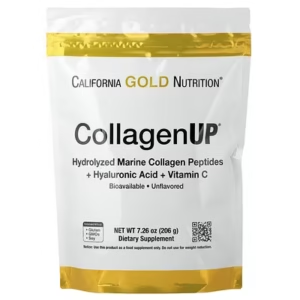
On iHerb, the label clearly highlights a formula containing:
- Hydrolyzed Marine Collagen Peptides
- Vitamin C
- Hyaluronic Acid
The product also states that it is:
- Unflavored
- Non-bovine
- Made from hydrolyzed fish collagen
- Free from gluten, soy, and GMOs
- Third-party tested
- Manufactured in a cGMP-compliant facility
From a label-reading perspective, this type of transparency helps consumers understand exactly where the ingredients come from and makes it easier to compare the product with similar collagen supplements.
2. Life Extension – Two-Per-Day Multivitamin
This product provides a clear example of a well-organized multivitamin label.
The Supplement Facts panel clearly states:
- Serving Size: 2 Capsules
- Servings Per Container: 60
It then lists each vitamin and mineral along with the amount per serving and the corresponding %DV, including nutrients such as:
- Vitamin A
- Vitamin C
- Vitamin D3
- Vitamin E
- Vitamin B1
This type of label leaves little room for guesswork and makes comparison shopping much easier.
3. NOW Foods – Magnesium Caps 400 mg
This product demonstrates another example of label simplicity and clarity.
The label clearly indicates:
- Serving Size: 1 Capsule
- Magnesium: 400 mg per serving
- Approximately 95% Daily Value
- Suggested Use: One capsule daily
Because the dosage and serving information are straightforward, consumers can quickly understand what they are getting without performing complicated calculations.
Warning Signs to Consider Before Spending Your Money
Even a well-designed label does not automatically mean a supplement is appropriate for everyone.
Medical experts caution that some supplements may:
- Interact with medications
- Cause side effects
- Increase risks when used at high doses
- Create problems when combined with multiple supplements
Research also reminds consumers that “natural” does not always mean “safe.” Some herbal products may affect liver function or may not be suitable during pregnancy, breastfeeding, or childhood.
The best approach is to combine careful label reading with an understanding of safety considerations and, when necessary, consultation with a qualified healthcare professional.
Learn to Understand Supplement Labels
Once you learn how to read a supplement label, shopping becomes much more informed and far less dependent on marketing claims.
Before purchasing, look for:
- Product name
- Serving size
- Servings per container
- Amount per serving
- Percentage Daily Value (%DV)
- Other ingredients
- Warnings and precautions
- Manufacturer information
When you encounter a transparent label like the examples above, you’re not simply buying a promise—you are buying information that helps you compare products and make smarter decisions.
Medical Sources